



Volume 41 · Number 7
JULY 2011
FDA warns of confusion in prescribing two dissimilar drugs
By Katie Kalvaitis

The FDA is notifying health care professionals and patients of medication error reports in which patients were prescribed the antipsychotic risperidone instead of the dopamine agonist ropinirole, and vice versa. In some cases, patients who took the wrong medication needed to be hospitalized.
The agency issued a Drug Safety Communication after evaluating 226 drug medication errors related to confusion between risperidone (Risperidal) and ropinirole (Requip). According to information provided by the FDA, 16 of the cases related to the administration of incorrect medication resulted in adverse events such as confusion, lethargy, ataxia, hallucinations, tiredness, dizziness, tingling, numbness and altered mental status. In one case reported outside of the US, a patient was given the brand-name drug Risperdal instead of Requip for 1 month before the error was noticed; the patient died, but it is unclear what role, if any, the error had in the death of the patient, according to the FDA statement.
Reasons for Confusion
Similar brand names, generic names, container labels and carton packaging, and illegible handwriting on prescriptions are some of the reasons cited for confusion between the two products.
“Given similar labels and carton packaging designs used by many generic manufacturers, when this factor is combined with similarities in drug names, overlapping product characteristics and proximity in stocking within pharmacies, there is considerable potential for product misidentification and medication errors,” the FDA statement reads.
The two products also have the same dosage form; daily or twice-daily dosing frequency; and dosage strengths (0.25 mg, 0.5 mg, 1 mg, 2 mg, 3 mg and 4 mg). Moreover, some of the generic manufacturers make both products, according to the agency.
The source of confusion was not stated for most cases of medication errors reported to the FDA Adverse Event Reporting System database and the Institute for Safe Medication Practices. In two cases, however, the cause of error was attributed to similarity in generic names and overlapping strengths. Proximity of products on the pharmacy shelf and similar packaging were also reported as contributing factors in two other cases.
According to the statement, the incidence of confusion between risperidone and ropinirole increased after 2006, with the introduction of generic product lines. Generic risperidone was approved in 2006 and generic ropinirole in 2008. However, the FDA does not discount the possibility that the similar brand names may also have added to the confusion.
Preventing Mix-Ups
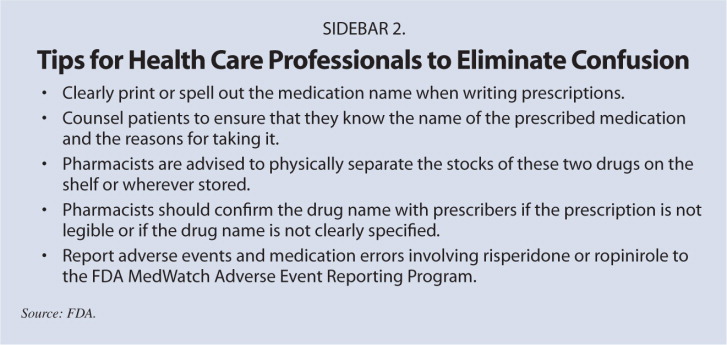
The agency provides a number of tips to help health care professionals and patients reduce their risk for confusing risperidone and ropinirole (See Sidebar 2).
Additionally, the FDA has requested that the manufacturers of the generic products and the two drugs — Glaxo-SmithKline and Johnson & Johnson — take measures to reduce the potential for confusion between the two products. Recommendations include using “tall man” lettering on container labels and carton packaging to present the generic names as risperiDONE and rOPINI-Role, which may improve the ability of health care professionals to distinguish between the two drug names.
For more information or to read the full Drug Safety Communication, visit FDA.gov.
Sidebar 1.
Two Different Medications, Similar Names
- Risperidone is an antipsychotic medication used to treat mental illness including schizophrenia, bipolar disorder and irritability associated with autistic disorder.
- Ropinirole is a dopamine agonist used in the treatment of Parkinson’s disease and Restless Legs Syndrome.
Sidebar 2.
Tips for Health Care Professionals to Eliminate Confusion
- Clearly print or spell out the medication name when writing prescriptions.
- Counsel patients to ensure that they know the name of the prescribed medication and the reasons for taking it.
- Pharmacists are advised to physically separate the stocks of these two drugs on the shelf or wherever stored.
- Pharmacists should confirm the drug name with prescribers if the prescription is not legible or if the drug name is not clearly specified.
- Report adverse events and medication errors involving risperidone or ropinirole to the FDA MedWatch Adverse Event Reporting Program.

This Issue: The Conundrum of Bipolar Depression
High Performers and Suicide Prevention in the Workplace
Sally Spencer-Thomas, PsyD, MMN
The Evolution of Bipolar Disorder
Metabolic syndrome risk in patients prescribed atypical antipsychotics: As comorbidities multiply, the debate over monitoring responsibilities continues.
Whitney McKnight
Executive summaries of essential clinical developments
Stacey L. Fisher;
Emily Shafer
Ninth International Conference on Bipolar Disorder • June 9–11 • Pittsburgh
Cassandra A. Richards
 A 34-Year-Old Mother with Religious Delusions, Filicidal Thoughts
Deborah Mendelson, MSW;
Fernando S. Goes, MD
A 32-Year-Old Male with Mania, Leg Pain, Migraines
Amy T. Peters, BA;
Andrew A. Nierenberg, MD;
Thilo Deckersbach, PhD
A 34-Year-Old Woman with Depression, Suicidal Ideation
Yakir K. Vaks, MD;
Bharat Nandu, MD
A 37-Year-Old Woman with Bipolar Illness, Sialorrhea
Deepa Hasija, MD;
Sree Latha Krishna Jadapalle, MD
A 56-Year-Old Male with Bipolar II, Dysuria
Ghulam-Murtaza Bajwa, MD;
Deepa Hasija, MD;
Sree Latha Krishna Jadapalle, MD;
Amel Badr, MD
A 43-Year-Old Male with Bipolar Disorder, Debilitating Depression
Jan Fawcett, MD
